


Dufourbit Warning: FCA Says the Firm Is Unauthorised—7 Checks Before You Pay
The FCA warned about Dufourbit on 19 August 2026. Check the named domain, contact details, missing protections and seven steps before making any payment.
Original

简体中文
繁體中文
English
Pусский
日本語
ภาษาไทย
Tiếng Việt
Bahasa Indonesia
Español
हिन्दी
Filippiiniläinen
Français
Deutsch
Português
Türkçe
한국어
العربية
اردو




Abstract:Police say 81-year-old duped by bogus high-return scheme after 15 online transfers to multiple bank accounts

An 81-year-old retiree has suffered losses amounting to RM303,958.50 after being drawn into what authorities later confirmed was a fictitious investment scheme circulated on Facebook. The case, described by police as a highly sophisticated form of online fraud, highlights how convincing digital scams have become, particularly for individuals seeking better returns on their savings.
According to Brickfields district police chief Assistant Commissioner Hoo Chang Hook, the incident began on 9 December when the retiree, who was at his home in Bukit Damansara, clicked on an investment-related link he encountered on social media. After engaging with the advertisement, he was added to an online group promoting a system referred to as SAC, which claimed to offer exceptionally attractive profits.
Believing the opportunity to be legitimate, the victim proceeded to invest a substantial sum through a mobile application known as Sacia Pro. He was later informed by the operators that his investment had generated profits exceeding RM9 million. The figures displayed on the platform appeared impressive and credible, reinforcing his confidence in the scheme.
Difficulties emerged when the retiree attempted to withdraw the purported returns. He was instructed to pay a 12 per cent commission, amounting to approximately RM110,000, as a prerequisite for releasing the funds. Trusting the assurances provided, he complied with the request. Despite being told that no further payments would be required, subsequent withdrawal attempts were blocked, and the suspects demanded an additional commission exceeding RM1 million.
Investigations revealed that all payments had been made through online transfers from the victims bank account into accounts specified by the syndicate. In total, the retiree carried out 15 transactions involving four different bank accounts. Repeated requests for further payments eventually raised suspicions, prompting the victim to realise that he had been deceived. He subsequently lodged a police report.
Further checks by investigators indicated that two of the bank accounts used by the suspects had already been linked to multiple prior scam reports, suggesting the presence of an organised fraud network rather than an isolated incident. The case is now being investigated under Section 420 of the Penal Code for cheating.
The incident comes amid a broader rise in scam-related crimes across Malaysia. Data from the Federal Commercial Crime Investigation Department (CCID) show a sharp increase in phone scams, with 481 cases recorded in January alone, representing a significant year-on-year jump. Financial losses associated with such scams have also escalated, reaching RM27 million for the month.
Authorities note that modern scam syndicates frequently impersonate representatives from banks, law enforcement agencies, courier services or government bodies. By fabricating urgent scenarios such as alleged debts, suspicious account activity or threats of legal action, scammers aim to trigger panic and pressure victims into revealing sensitive information or transferring funds.
Police have reiterated the importance of vigilance when encountering unsolicited investment offers or unexpected phone calls. Members of the public are strongly advised never to disclose banking credentials, identification details or one-time passwords to unknown individuals. Any suspicious claims should be verified directly with the relevant institutions through official channels.
As fraud tactics continue to evolve, officials emphasise that awareness, scepticism and prompt verification remain among the most effective safeguards. Even schemes that appear professional and well-structured may conceal deceptive intentions, making cautious decision-making essential in todays digital environment.
Disclaimer:
The views in this article only represent the author's personal views, and do not constitute investment advice on this platform. This platform does not guarantee the accuracy, completeness and timeliness of the information in the article, and will not be liable for any loss caused by the use of or reliance on the information in the article.
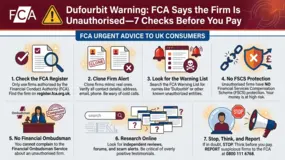
The FCA warned about Dufourbit on 19 August 2026. Check the named domain, contact details, missing protections and seven steps before making any payment.
Was your trading experience with Warren Bowie & Smith, a Mauritius-based brokerage entity, not so fruitful? Did the broker tempt you into trading by giving you assurances of profits that never appeared on the Warren Bowie & Smith login dashboard? Did you struggle to withdraw profits from the trading platform? Upon your withdrawal request, did the broker official make you invest further? This Warren Bowie & Smith review examines serious trading allegations against the broker. Additionally, we have provided the broker’s regulatory status.

Angel One, an India-based brokerage entity, constantly receives allegations from users online. Users are complaining about withheld funds, poor customer support service, undesired trade execution orders, etc. In this Angel One review, let’s quickly go through these complaints, understand its regulatory framework and pay attention to the product portfolio.
AuroraEx, a United States-based multi-asset brokerage entity, is facing serious user allegations over how it handles deposited funds. Many users have accused the broker of failing to meet its payment obligations. Some have questioned the broker over possible trade-related foul play, while others have alleged that it scammed them through a Ponzi operation. This AuroraEx review examines these user-reported allegations and provides an overview of the broker’s regulatory status.
WikiFXWikiFXWikiFXWikiFXWikiFXWikiFXWikiFXWikiFXWikiFXWikiFX