

عالمی بروکر ریگولیشن چیک کرنے والا ایپ
WikiFX
اردو
简体中文
繁體中文
English
Pусский
日本語
ภาษาไทย
Tiếng Việt
Bahasa Indonesia
Español
हिन्दी
Filippiiniläinen
Français
Deutsch
Português
Türkçe
한국어
العربية
اردو


Crypto Liquidity for Brokers in 2026: Why a Bigger Order Book Is Not Yet a Safer Execution Model

WikiFX
|


خلاصہ۔:Crypto liquidity for brokers is not simply a question of how many venues appear in an order-book feed. A broker needs a controlled model for executable depth, routing, custody boundaries, credit, price integrity, market-data records, outages, and client communication. This 2026 guide explains how a cryptocurrency liquidity provider, crypto LP forex setup, digital asset liquidity arrangement, and crypto liquidity aggregation layer can fit into a broker-owned service. It outlines the questions to ask before onboarding, the tests that reveal gaps during volatile conditions, the evidence needed for reconciliation and disputes, and a 90-day launch plan. It does not rank providers or promise better fills. Its purpose is to help a broker decide whether it can explain, supervise, and recover the connected crypto execution service for the actual instruments, clients, and jurisdictions it serves.
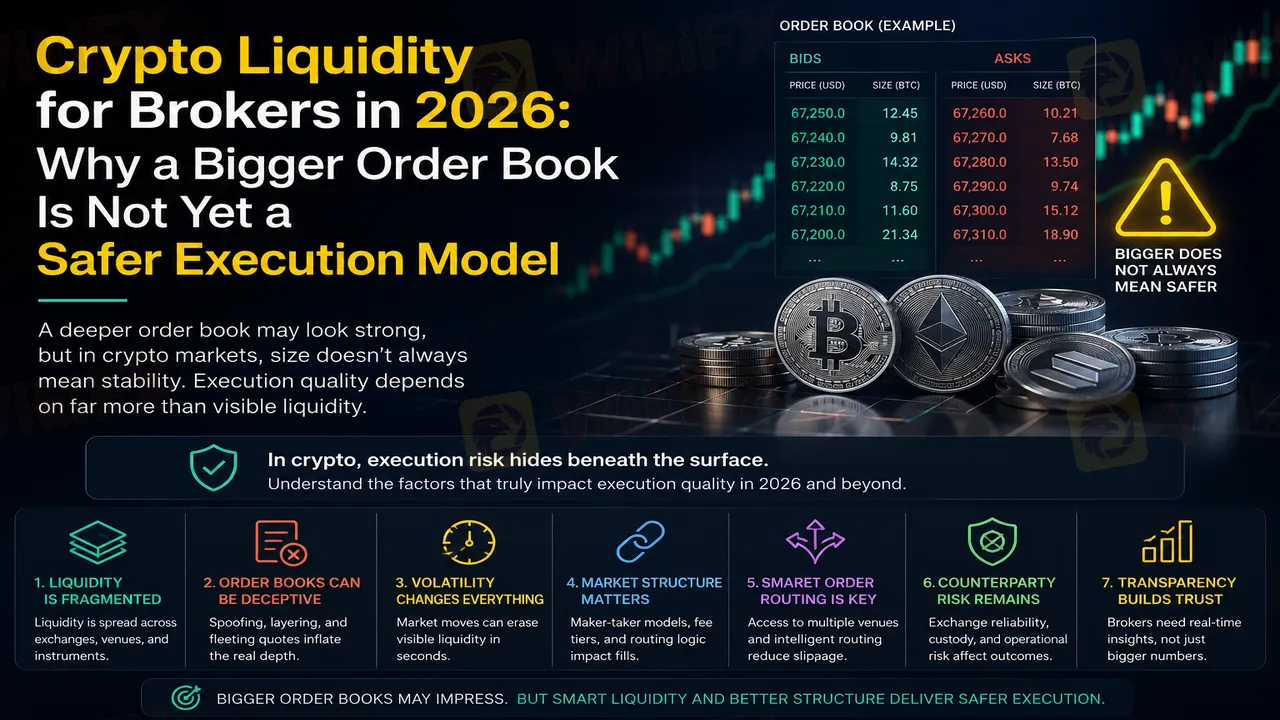
The first crypto-liquidity demo often looks reassuring: several venues, visible depth, fast routing, and a dashboard full of prices. The harder test comes when one venue pauses, a wallet or custody boundary needs investigation, or a client asks why an order status changed during volatility. At that point, crypto liquidity for brokers is not a feed. It is an operating model.
 فہرست
فہرستExecutive Takeaways
- A cryptocurrency liquidity provider should be assessed through executable service, controls, and records - not venue count alone.
- Digital-asset liquidity combines trading, technology, custody, credit, data, and client-service dependencies that must be mapped explicitly.
- Test a stale feed, route failure, partial fill, limit event, custody/settlement exception, and end-of-day reconciliation before launch.
- For Indonesia, crypto-asset market oversight is now within OJK's framework; check the current applicable permissions and reporting obligations rather than relying on historic assumptions.
- Use clear, fair, non-misleading client language. A liquidity connection does not guarantee execution, availability, or asset protection.
Crypto Liquidity is an Execution Chain, Not a Venue List

Editorial illustration: a broker-owned crypto-liquidity control hub monitoring market streams, routing, custody boundaries, risk limits, and verified order records.
Digital-asset execution may involve a provider, aggregation technology, market-data feeds, order routing, settlement or custody arrangements, risk controls, and client-facing platform logic. Each element may have a different owner. The broker needs a single map that makes the actual chain visible.
| Question | Broker control needed | Evidence to retain |
| Price and depth | source policy, stale/crossed-price rules, ticket bands | time-stamped samples, filter settings |
| Execution | route selection, fills/rejects, partial-fill behaviour | order IDs, reason codes, route logs |
| Custody and settlement | legal/operational boundary and exception escalation | contract scope, reconciliation process |
| Risk and limits | who changes limits, collateral or exposure rules | approval record, alerts, fallback action |
| Client service | authoritative order status and incident wording | support playbook, message templates |
**Common mistake:** treating displayed depth as proof that the same quantity is executable for the broker's intended clients, order size, and market condition.
2. The Crypto-specific Gaps That a Forex-style LP Checklist Can Miss
A crypto LP forex proposal may share concepts with traditional liquidity, but digital assets introduce additional boundaries. Markets may operate continuously; trading and settlement dependencies can be closer together; asset availability can change; and the broker may need to explain external venue, blockchain, custody, or wallet-related events without claiming control it does not have.
Use a written due-diligence pack to establish:
- The contracting entity, jurisdictions, instruments, and permitted client scope.
- What is priced, what is executable, and how an asset is added, paused, or removed.
- The order lifecycle, from client action through route acknowledgement, execution, allocation, settlement/custody status where applicable, and final record.
- The difference between a provider's data, the broker's platform state, and the source of truth for a client investigation.
- The owner and timing of each client-facing notice during an outage, abnormal market event, or material change.
Composite Scenario: Liquid on Screen, Unclear in the Exception Queue
This illustrative scenario is not a customer case study. A broker enables crypto liquidity aggregation and sees better visible depth during a routine test. In a volatile session, one input is delayed and another route pauses a market. The trading platform continues to display the asset briefly while some orders are rejected. Operations can see an event but cannot tie the route change to client-facing statuses or fee records. The corrective action is a controlled test protocol: feed-health thresholds, route-switch records, a defined order-state vocabulary, reconciliation samples, and approved support wording.
3. Build a Broker-owned Control Model Before Adding More Digital-asset Liquidity
More streams can reduce reliance on a single source, but they also create more routing, data, and recovery decisions. The broker should retain governance over configuration changes, price filters, instrument availability, alert thresholds, incident classification, and the client communication path.
The model should be tested in normal and stressed conditions. Test not only how quickly a route switches, but whether records remain complete, whether fees and adjustments reconcile, and whether support can explain the event without speculating.
Need the Crypto Liquidity due-diligence checklist?Dapatkan Checklist via WhatsApp
4. What to test before a live crypto-liquidity rollout
| Test | What to capture | Decision use |
| Depth by size and session | quote/fill samples by ticket band | client segments and display rules |
| Feed degradation | detection threshold, filter, alert, recovery | price-integrity control |
| Route or venue failure | route state, failover, client status | resilience and support readiness |
| Reject/partial fill | reason code and consistent timestamps | dispute handling |
| Custody/settlement exception | escalation boundaries and records | operational accountability |
| Reconciliation | orders, fills, fees, adjustments, balances | financial control and reporting |
Regulatory frameworks increasingly focus on traceable records and fair, orderly operation. ESMA's MiCA materials describe standardised order and trade record-keeping for relevant crypto-asset service providers; its platform rules include transparent operating rules and objective criteria for order execution. These are not a substitute for local advice, but they underline why a broker should not accept opaque execution data.
5. Indonesia: Permission, Records, and Client Communication Boundaries
In Indonesia, OJK states that digital-financial-asset and crypto-asset regulation and supervision moved from Bappebti to OJK in January 2025. OJK's current public materials cover the digital-asset trading ecosystem, reporting, and permits; a 2026 implementing regulation takes effect on 1 September 2026. A broker should obtain specific legal/compliance confirmation for its intended service, entities, products, promotion, and client scope.
The operational implication is straightforward: do not describe a global liquidity provider, wallet connection, or payment method as Indonesian authorisation. Make Bahasa Indonesia risk notices, order statuses, KYC/onboarding explanations, incident notices, and complaint escalation match the record and the real service boundary. Keep marketing fair, clear, and non-misleading.
6. 90-day Launch Plan
| Period | Objective | Evidence before the next gate |
| Days 0-20 | Define clients, assets, policy, and dependencies | scope, legal review, execution map, risk checklist |
| Days 21-45 | Validate provider, custody/settlement, records, and costs | written answers, data samples, commercial model |
| Days 46-70 | Configure and rehearse normal/stress cases | test logs, reconciliation, support wording, rollback plan |
| Days 71-90 | Limited release and review | monitored results, exception register, go/no-go decision |
FAQs
What is crypto liquidity for brokers?
It is the combination of market access, executable pricing and depth, technology connectivity, risk controls, records, and relevant settlement/custody boundaries that let a broker provide a crypto execution service. The exact scope depends on the legal and operating model.
Does a cryptocurrency liquidity provider guarantee better prices or fills?
No. A larger venue list or displayed order book does not guarantee executable quality. Test actual depth, routes, limits, conditions, records, and recovery behaviour for the broker's target flow.
What should be monitored after launch?
Monitor quote and fill behaviour, depth by relevant size, latency, feed/route events, rejects, fees, reconciliation breaks, custody/settlement exceptions, incidents, and client complaints against pre-agreed thresholds.
Conclusion
Crypto liquidity becomes a scalable broker service only when the broker can explain the whole execution story - how a price was selected, where an order travelled, what records prove the outcome, and how an exception is recovered. A larger order book is useful; a controllable operating model is essential.
Want the implementation checklist before selecting a provider?Dapatkan Checklist via WhatsApp
Sources and Further Reading
- OJK: digital financial assets and crypto-asset trading rules, 2026
- OJK: licensing for digital financial assets and crypto assets
- ESMA: MiCA and order-book/record-keeping standards
- ESMA: MiCA Article 76 trading-platform operation
- FCA: cryptoasset financial-promotion guidance
ڈس کلیمر:
یہ مضمون صرف مصنف کی ذاتی رائے پر مبنی ہے، یہ پلیٹ فارم کی سرمایہ کاری کی مشورہ نہیں ہے۔ پلیٹ فارم مضمون کی معلومات کی درستگی، مکملیت اور بروقت ہونے کی کوئی ضمانت نہیں دیتا، اور مضمون کی معلومات پر اعتماد یا استعمال سے ہونے والے کسی بھی نقصان کی ذمہ داری قبول نہیں کرتا۔
